

Custom Ski Suit Guide: Five Key Selection Factors for Waterproofness, Breathability, Thermal Construction and Snow Scenarios
The biggest difference between ski suits and ordinary winter jackets lies in their working environment: low temperatures, wind and snow, high humidity, plus a wide range of body movements all at once. If you overdress, you will sweat heavily while skiing and feel cold the moment you stop. Insufficient waterproofing means snowmelt seeps in after a few falls. An unsuitable fit restricts movements when raising arms for poles or bending knees to edge turns. When clubs, ski training camps and competition teams customise ski suits, simply opting for “thicker and warmer” designs often results in bulky garments that look warm but perform poorly on snow.
The core of ski suit customisation is striking a balance among waterproof performance, moisture permeability, warmth retention and freedom of movement. Below are five critical points to verify during selection and procurement.
1. Waterproof and Moisture Permeability Ratings: Do Not Focus Only on “Waterproof”
Fabric performance of ski suits is generally measured by waterproof rating and moisture permeability rating. The waterproof rating indicates the fabric’s resistance to snowmelt penetration, while the moisture permeability rating defines how efficiently sweat vapour escapes. Both indicators must be evaluated together: a waterproof fabric with poor breathability traps sweat against the skin after a run; a breathable fabric without adequate waterproofing soaks quickly after falls.
Instead of merely asking whether the fabric is waterproof, buyers should confirm specific waterproof and moisture permeability figures, and distinguish inherent fabric waterproofing from surface durable water repellent (DWR) treatment. Surface DWR fades with washing and abrasion. The composite membrane and taped seam construction are what truly block snowmelt infiltration. Details such as taped seams and waterproof zippers reflect the manufacturer’s craftsmanship better than fabric specifications alone.
2. Thermal Construction: Layering Works Better Than Simple Thickness
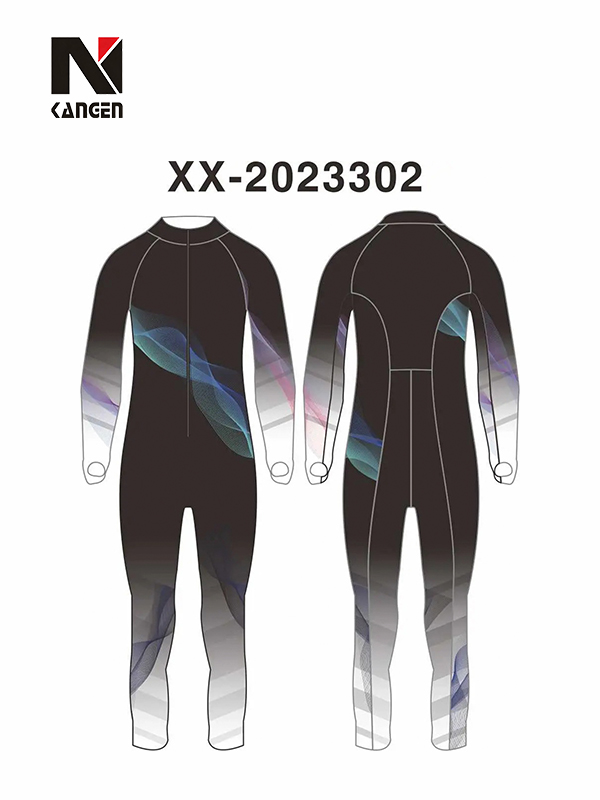
Warmth in ski suits is not achieved by stacking thick layers in one garment, but by a layered system. The base layer wicks sweat and dries rapidly; the mid layer retains heat; the outer layer blocks wind and water. If a manufacturer only offers “thick padded jackets” for customisation, it means they have not engineered the suit for actual snow sports conditions.
Professional thermal setups are adjusted according to usage scenarios. Alpine skiing and low‑temperature training require heavier insulation filling, while ski camps and youth suits balance mobility and heat dissipation to avoid overheating and sweating during activity. Buyers should confirm the type, weight and placement of insulation materials, and check whether sweat‑prone zones such as the underarms and back are thinned or fitted with breathable panels.
3. Compatibility with Snow Scenarios: Different Needs for Alpine Skiing, Snowboarding and Training Camps
There is no universal ski suit. Alpine skiing prioritises windproofing, waterproofing and warmth, with a relatively tailored fit to reduce wind catch. Snowboarding involves extensive movement, so suits are usually cut more generously to accommodate greater shoulder, hip and knee mobility. For ski camps and young athletes, priorities include stain resistance, wash durability, growth allowance and cost control.
Buyers should clarify the primary application before customisation: competitive training or recreational skiing? Alpine outdoor resorts or indoor snow centres? Indoor snow centres maintain relatively stable temperatures but demand higher breathability and sweat management. Outdoor resorts require robust wind protection, snow shielding and cold‑weather insulation. Fabric specifications and pattern cuts must be adjusted to match each scenario.
4. Pattern Cut and Mobility: Test Arm Raising, Knee Bending and Torso Rotation
Ski suit patterns must fit skiing movements, not just a static standing posture. Skiing involves reaching forward with poles, bending knees for edge control and rotating the torso. These actions place high mobility demands on the shoulders, back, elbows and knees. Patterns designed like regular winter coats will pull across the shoulders, bunch fabric under the arms or bind tightly around knees during skiing.
Three key movements should be validated during sampling: reaching forward with both arms to hold poles, deep knee bending for turning, and torso rotation left and right. Also check the connection between cuffs and gloves, whether the hem rides up when bending over, and the fit between trouser cuffs and ski boots. Youth ski suits need extra growth allowance so they remain wearable beyond one snow season.
5. Sampling and Reorders: Pre‑Season Bulk Delivery, Production Capacity and File Archiving
Ski suit orders are heavily concentrated before the snow season. Clubs and training camps often place orders one or two months before opening, which places heavy pressure on manufacturers’ scheduling capacity. Reorders are another practical concern: ill‑fitting sizes, in‑season damage and follow‑up batches require suppliers to preserve pattern data and fabric batch records.
Sourcing from an original factory with in‑house production brings clear advantages: controllable scheduling, traceable fabric batches and archived pattern files. Kang’en (Tianjin) Sporting Goods Co., Ltd. operates an integrated R&D, manufacturing, sales and service model. Core workflows including design, sampling, cutting, sewing and quality inspection are completed within its own factory. The company holds ISO 9001 Quality Management System, ISO 14001 Environmental Management System and ISO 45001 Occupational Health and Safety Management System certifications. Its brand BRIGHTSIDE won the bid for the competition apparel procurement project of the Jiamusi Speed Skating Team for the 16th Provincial Games. It has proven project experience in measuring, sampling and bulk delivery for ice and snow sportswear, with a product range covering ski suits, short‑track cut‑resistant one‑piece suits, long‑track speed skating suits and other ice‑snow apparel.
Three Practical Recommendations for Buyers
Confirm the usage scenario first, then set fabric parameters. Alpine skiing, snowboarding, indoor snow centres and training camps have different waterproof and breathability requirements; do not apply one set of specifications to all scenarios.
Conduct dynamic validation during sampling. Have athletes wear samples to practise poling, knee bending and torso rotation, and closely check shoulder-back mobility, cuff sealing and hem retention.
Verify reorder support and fabric archiving capabilities. Mid‑season supplementary orders are common. Whether the manufacturer retains pattern files and fabric batch records directly determines consistency and lead time for repeat orders.
The essence of ski suit customisation is balancing waterproofness, breathability, warmth and mobility for your specific scenario. Verifying these five points one by one is far more reliable than simply comparing prices and thickness. For ski suit customisation or ice‑snow sportswear solution enquiries, please contact Manager Xie at +86‑138‑2117‑2751 for tailored product information and quotations.


